For years, school dress codes have been debated between students, parents, and admin alike. They are often explained as necessary for maintaining discipline, modesty, safety, and professionalism. But the truth is, these policies are a targeted and inconsistent way to prevent students from expressing themselves. They are enforced in a pattern that promotes gender bias, body shaming, and even interrupts students’ education. Though situationally, school dress codes can be helpful, dress codes have a pattern of causing more harm than good.
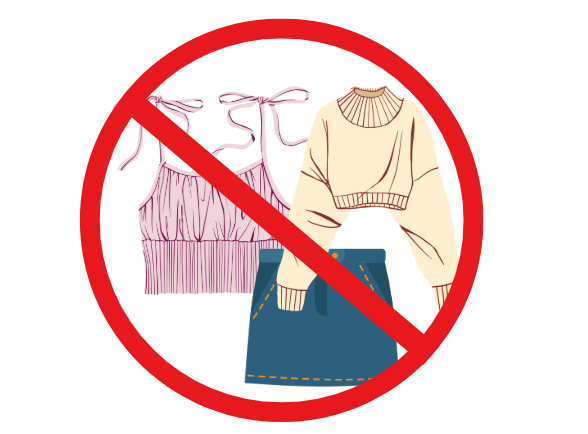
School dress codes should be removed or heavily revised because they target female students, creating a sexist, insecure, and exclusionary environment. Most dress codes include rules that only apply to girls— such as tank tops, skirts above mid-thigh, or showing midriff and/or shoulders, while similar restrictions are rarely applied equally to boys. Critics argue this reinforces the idea that girls’ bodies are “distracting” and need policing. This can create insecurities and low self-confidence.
According to wifitalents.com, 84% of school dress code policies have been criticized for being sexist or gender-biased, and 64% of girls report feeling shame or embarrassment because of these policies. Dress codes that treat clothing as a distraction place responsibility on girls for boys’ behavior, rather than teaching respect and self-control. This sends a damaging message— that girls must modify their bodies and clothing to make others comfortable, contributing to anxiety.
On the other hand, 93% of public school districts in the United States have some form of student dress code policy (Government Accountability Office (GAO) report). Meaning that it would be difficult to remove dress codes since they are such a normalcy. Also, most dress codes are not that strict, so creativity is limited, but not prohibited. Not only do they generally give leeway for self-expression, but they also increase professionalism. If there are no restrictions, eventually there will be a decrease in productivity.
HIM Business School says that school dress codes enhance cognitive performance. However, even though dress codes are common and intended to promote professionalism and productivity, they still place unnecessary attention on appearance and even get in the way of academics.
These policies are not just unfair— they can lead to poor academic outcomes. Schools that are stricter about dress codes often remove students from class, which ultimately disrupts classes for students and teachers alike. So, even though dress codes are said to “eliminate distractions,” they actually do the opposite. Interrupting an entire class or sending a student away to change takes more time away than anything that an exposed shoulder could do.
Teachers at Concordia University St. Paul also point out the subjective nature of many dress codes, such as using terms like “appropriate,” “distracting,” or “immodest,” which leaves enforcement up to individual interpretation, leading to inconsistent and often unfair discipline.
Eliminating school dress codes entirely is an impossible idea, however, current policies could use some rethinking. Standards that encourage equality and consistency are important, as well as prioritizing focus in classrooms rather than policing bodies and causing disruption.
Ultimately, schools should focus on creating a fair and respectful learning environment by revising dress codes to support academic success rather than promoting bias and unnecessary discipline.