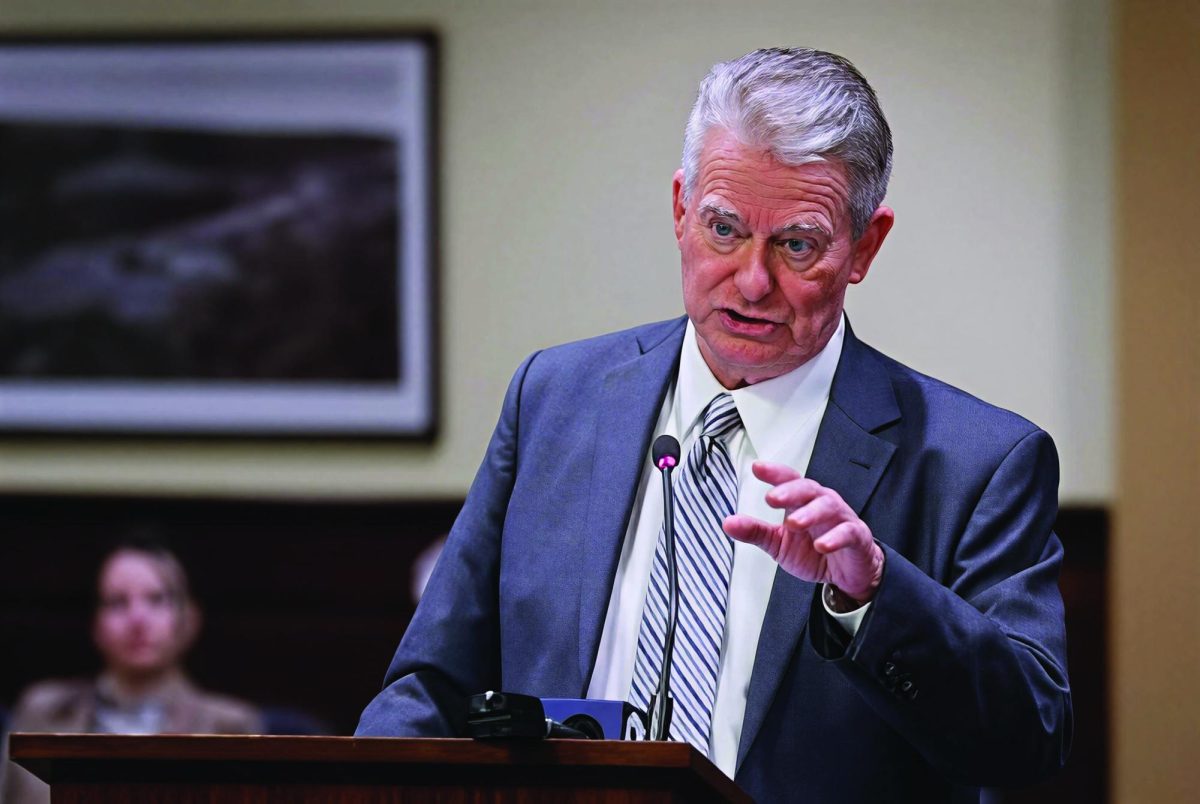
Recently, Idaho Gov. Brad Little passed House Bill 623, requiring all individuals who attend public school to remain silent for a minimum of 60 seconds every morning after the day starts. Many are in opposition to this bill, claiming that if an individual would like to practice this they have the ability to on their own, and that making it law is unnecessary. Others also believe that it is a way of creating a backdoor that encourages prayer for students and that it seems suspicious, despite it appearing neutral. But, in actuality, it’s a helpful law that has the capability to improve many students’ school days going forward.
This type of law is not completely unheard of and unnecessary. Along with Idaho, 34 other states have already implemented this law in their public schools because of its benefits. According to health.clevelandclinic.org, a nonprofit academic medical center that integrates clinical and hospital care, sitting in silence can lower your blood pressure, decrease your heart rate, steady your breathing, reduce muscle tension and increase focus and cognition. All of these are shown to help in school settings and potentially improve grades.
Although it may seem silly at first, the action of turning it into a law isn’t as outlandish as people make it out to be. When constantly surrounded by peers talking to each other, each busy on their phones and Chromebooks, it can be difficult to take oneself out of an interaction to sit alone for 60 seconds or more. It’s been recorded at psycnet.apa.org, the leading scientific and professional organization representing psychology in the US, that the fear of missing out (also known as FOMO) can affect a person to different degrees, and it’s more common than one might believe so. Assuming that a student does not have severe FOMO that would prevent them from removing themselves from a chaotic setting, in a typical classroom, it’s still not usually quiet around them. Classrooms are often noisy in the morning because students have just arrived at school and are catching up with their friends. Sometimes, because of routines at the beginning of class, a student also wouldn’t have the full capability to take a minute out of the start of their day to meditate or pray, or however they use that time. What if a kid doesn’t arrive at class until right before the bell rings? Or, what if the teacher likes to discuss the agenda for class before the bell rings?
As one can see, there are varying reasons as to why a student might not be able to take the first 60 seconds out of school to dedicate it to silence. And even if they do, it’s difficult to remain that way for the entire minute due to the distracting environment. Therefore, despite having some understandable pushback, House Bill 623 will do more help than harm. It has good reason to become a permanent practice for future generations.